アメリカ合衆国
アメリカ合衆国PA11 is a type of polyamide used primarily in SLS technology and is very rare in the field of FFF 3D printing. Commonly used PA6 and PA12 polyamides have several disadvantages: PA6 is extremely hygroscopic, making it very difficult to print with it even 1 day after unpacking. PA12 isn’t as hygroscopic, but it warps extremely and has very poor adhesion to standard print sheets. PA11 is a good middle ground – it’s less hygroscopic, warps less, and offers better adhesion to various print surfaces.

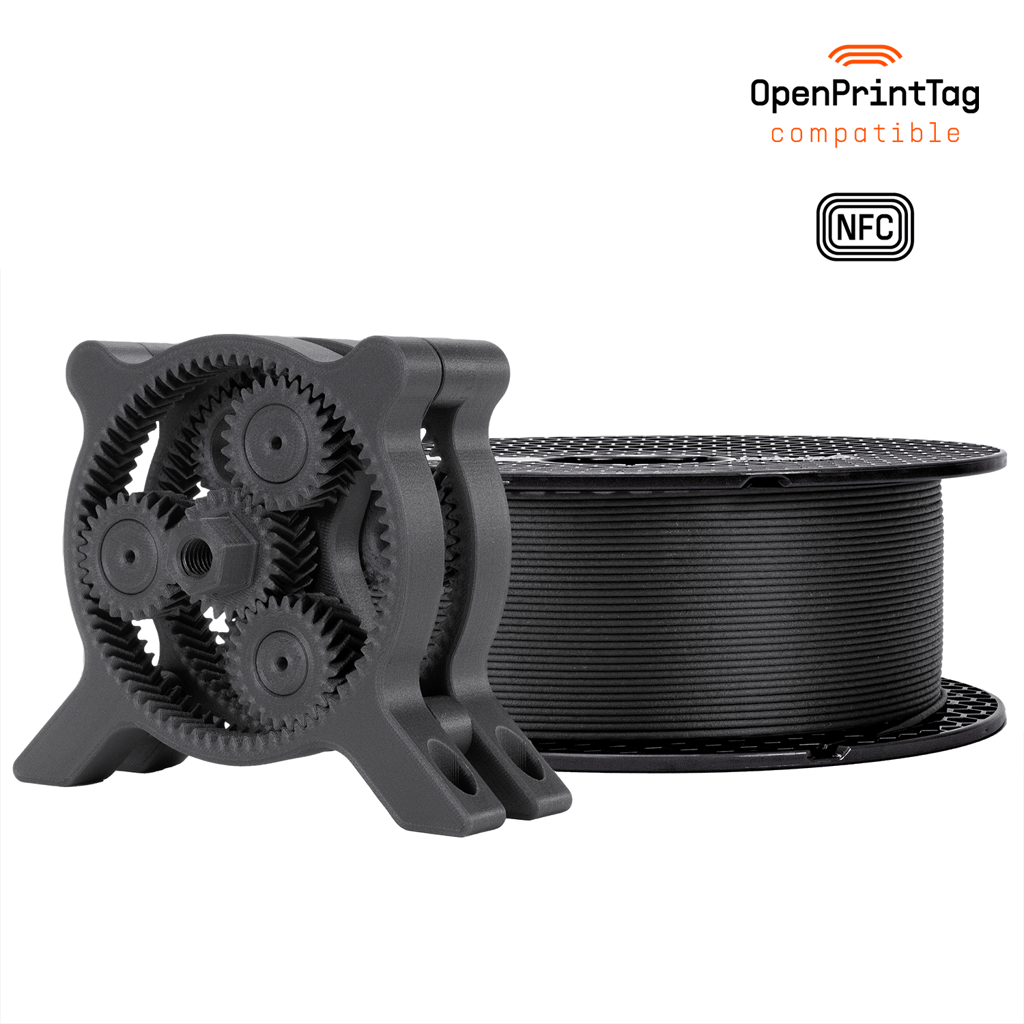
Prusament PA11 Carbon Fiber offers low friction and good abrasion resistance. Combined with decent mechanical properties (impact and tensile strength), it's perfectly suitable for printing gears and other moving parts.

PA11 has good resistance to bases (e.g. NaOH), alcohols (Methanol, Ethanol), toluene, acetone, motor oil, petrol, diesel, etc. This makes it usable in laboratories and, again, in automotive and other demanding industry fields.

Prusament PA11’s tensile strength anisotropy coefficient reaches r=0.84 when printed with Prusa Core One+. This is the highest value of all Prusaments. This means the material is much harder to break and withstands stress in every direction, no matter the layers’ orientation. This vertically printed umbrella holder serves as a good example.
Before printing, learn about print surface preparation in our dedicated article and material table.
Prusament PA11 can easily peel and warp when printed on conventional sheets. Sure, smaller models with sparse infill can be printed on PEI sheets coated with stick glue, but for reliable printing of technical models, you need something better. Prusament PA11 in particular can easily peel and warp when printed on conventional sheets. That’s why we have developed a new surface layer of a special material that provides significantly better adhesion for polyamide printing materials.

You can buy the sheet here.
Everything you need to know before printing