Get custom parts in hours, not weeks, with Prusa CORE One+
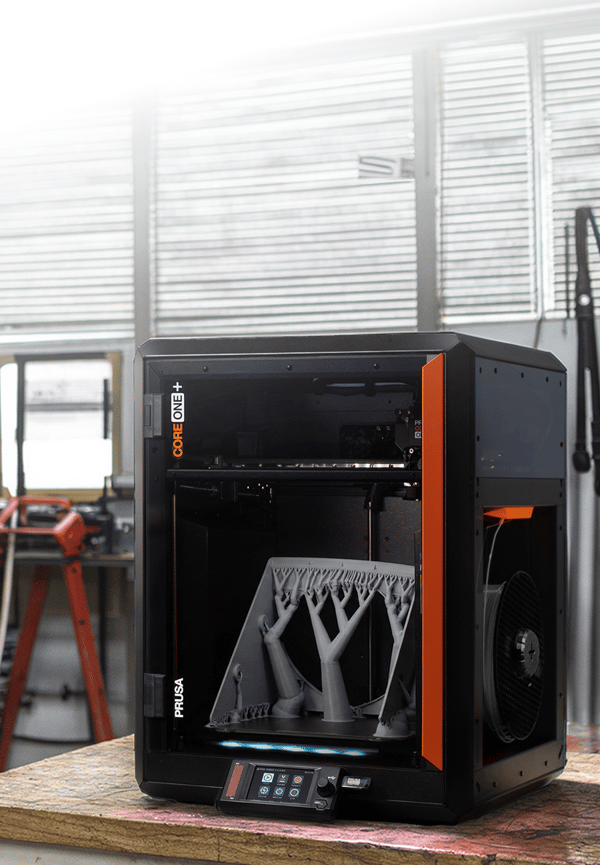
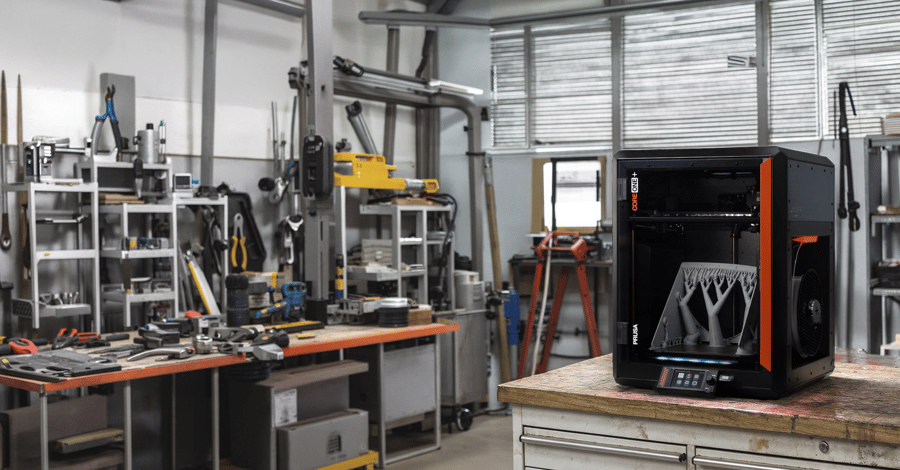
Prusa CORE One+ is a fully enclosed desktop 3D printer that runs unattended — no specialist, no vendor, no waiting.

Engineers
Designs without waiting for vendors.
Manufacturing
Never stop your manufacturing line.
Sourcing
Make parts just in time.
Security
Keep IP under your roof.
In-house 3D printing designed for engineering, manufacturing, and secure operations. No vendor delays, no data leaks.
Calculate Your Part Costs
Secure. Files stay local.
Large installations at





Professional 3D printers for your business with enclosed print chamber. Designed and manufactured in Prague for companies that need high reliability and data security. Trusted by 110,000+ businesses worldwide.
9,952 reviews onTrustpilot
Why choose Prusa?
American-European company with manufacturing in Wilmington and Prague.
ISO 9001, ISO 14001, ISO 45001 certified
Online 3D training with certification included
60 day money back guarantee
TAA Compliant
24/7 tech support
No material vendor lock-in
Prusa is the secure option
95% of desktop 3D printers sold are made by Chinese companies. Prusa is the remaining 5%. Does origin matter? Yes.
All Chinese companies are required to cooperate with state intelligence (National Intelligence Law, 2017), hand over encryption keys (Cryptography Law, 2020), and provide data to authorities regardless of where it's stored - even on EU or US servers (Data Security Law, 2021). Product designs and 3D models a legitimate target too (2023 Counter-Espionage Law update).
“There is a real risk that data on prints, design models, or production processes could be transmitted to servers beyond the user’s control, including to the territory of the PRC.”
CORE One+ is TAA compliant, which is required for US government and federal contractor purchases.
Start 3D printing today
Two ways to get started:
CORE One+ Assembled
$1,332Get the printer
- In stock
- Ships immediately
- 60-day money back
What's included in the box:
- Prusa CORE One+ 3D Printer (Fully Assembled)
- Double-sided Textured PEI Satin Powder-coated Sheet
Best value — only $67 more
CORE One+ Business Starter Pack
$1,399Get the Starter Pack
- In stock
- Ships immediately
- 60-day money back
Everything you need to print functional production parts on Day 1:
- Prusa CORE One+ 3D Printer (Fully Assembled)
- Prusament PETG Jet Black 2kg (NFC)
- Prusament PC Blend Natural 900g (NFC)
Equipping a team or building a print farm?
Tell us what you need. We'll tailor a setup and quote.
Get a custom quoteVolume pricing · Dedicated support · We respond within 24h
“3D printing saves us about 100 work hours per aircraft. The printer just runs next to the workshop - no special operator, no special department.”
Shark.Aero is a small ultralight plane manufacturer using Prusa 3D printers for prototyping, production parts manufacturing and carbon fiber mold making.

CEO, Shark.Aero

6 reasons to bring 3D printing in-house:
Stop waiting weeks for outsourced parts
Print them overnight. You send a file in the evening, pick up the part in the morning. No quoting, no back-and-forth, no shipping delays.
Test 10 design iterations for the price of one prototype
A kilogram of highly consistent Prusa filament costs $30. That's dozens of test prints. You can afford to get it wrong five times and still come out ahead.
Make jigs and fixtures in-house in days, not weeks
Your team knows what they need. Skip the procurement cycle — design it, print it, use it on the shop floor the same week.
Print replacement parts that are no longer available
Machines outlive their spare parts supply. Instead of hunting for a discontinued bracket or waiting on a custom machining quote, just print it.
No minimum order quantities
Need 12 pieces? Print 12 pieces. You don't need to order 500 to get a reasonable unit price. Production starts at one.
Move faster than companies ten times your size
Big companies wait on procurement, approvals, and vendor lead times. You can have a part in your hand tomorrow. That matters.
Customer StoryOver 100 3D-printed parts in every aircraft
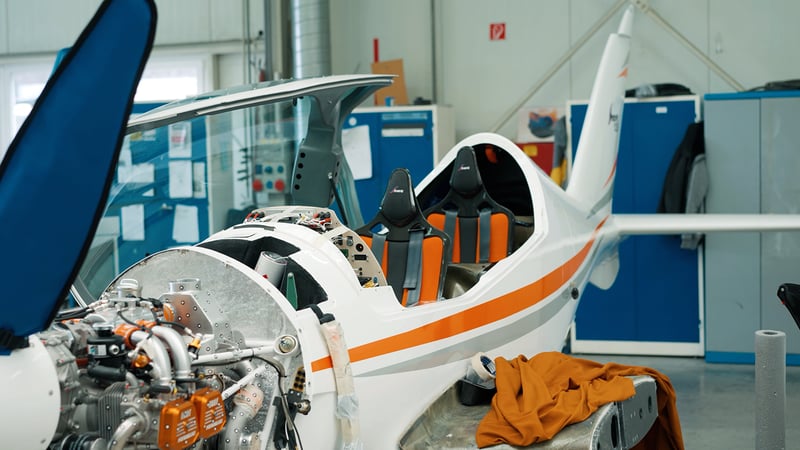
Shark.Aero engineers the fastest ultralight aircraft in the world. Not models - real planes that carry people. One of their Sharks was flown solo around the world by the youngest woman to ever do it. The whole aircraft weighs just 350 kg and cruises faster than most ultralights in its class.
Parts that actually fly
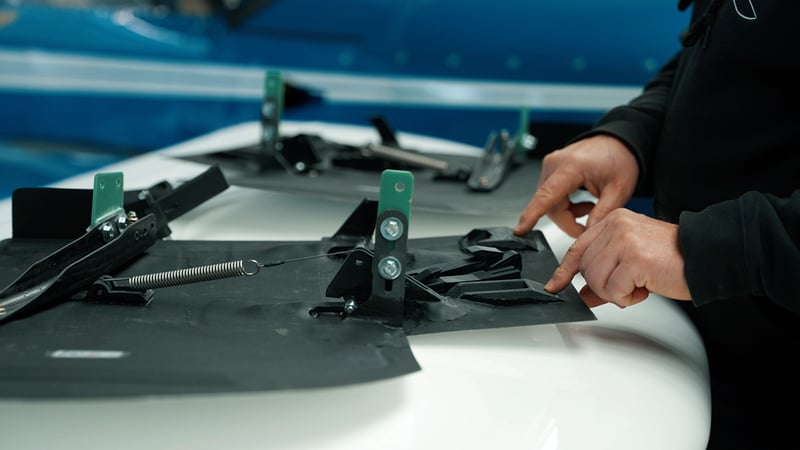
Most printed components sit under the hood - brackets, ducts, covers, and housings printed from ABS for its temperature resistance. Parts near the engine cooling system are printed in nylon, which handles the heat. The cockpit control grip - the thing the pilot holds for the entire flight - is printed on a Prusa resin printer. These aren't prototypes waiting to be replaced by 'real' parts. They're final production components that go into every aircraft that leaves the hangar.
Molds and master models
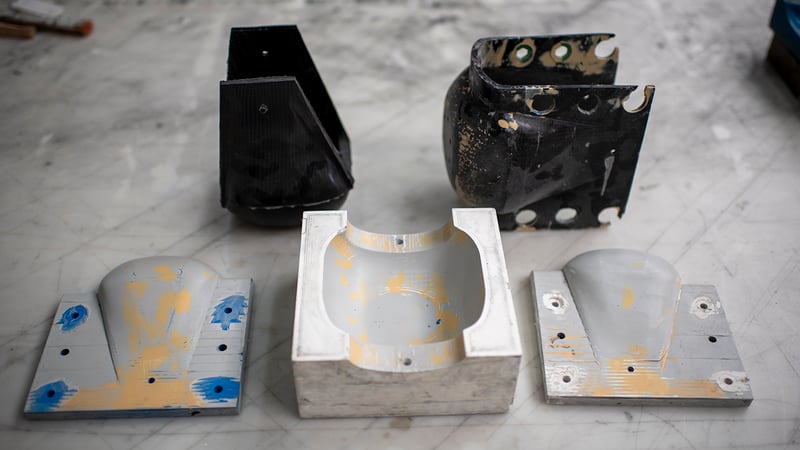
Before a carbon fiber composite part goes into serial production, Shark.Aero prints a master model for testing and trials. Each aircraft requires around 200 carbon composite components - the fuselage, wings, panels - all laid up by hand into molds. 3D-printed tooling helps the team prepare and verify these molds before committing to the expensive composite layup process. Getting a mold wrong means days of lost work. A printed test piece costs a few euros of filament and a couple of hours.
Workshop tooling
Beyond the aircraft itself, the workshop is full of printed tools, jigs, and fixtures that the team uses every day. Custom-shaped holding fixtures for oddly shaped composite parts during bonding. Alignment tools for assembly. Things that would otherwise need to be machined or jury-rigged out of whatever's lying around.
Development and iteration
The retractable landing gear doors took 10 years of development. Vlado Pekar describes the process as constant trial and error - countless variations printed, tested, adjusted, and reprinted. The final working doors are a hybrid of carbon composite and 3D-printed parts. The payoff: an extra 10 km/h of speed from cleaner aerodynamics. That kind of iteration would be financially impossible if every version had to be outsourced or machined.
“Who would have thought that a plane with 3D-printed parts can fly around the world?”

What makes this story relevant to your business isn't that you're building planes. It's that Shark.Aero is a small team doing exactly what you'd do with a CORE One+: printing production parts, making their own tooling, iterating on designs without waiting for vendors, and keeping manufacturing in-house. Their parts are reliable enough to fly. Yours don't have to be.
All the information you need to get started:
Fundamentals, success stories, and our complete material portfolio: the ideal starting kit to take your business to the next level. All free.
- Aviation

- Automotive / Racing

- Manufacturing
- Manufacturing

- Manufacturing

- Design / Manufacturing

- Education

- Architecture

- Business case studies
- Basics of 3D printing e-book
- Prusament 3D printing material catalogue
Loading form…
In-house 3D printing vs. outsourcing
Compare lead time, cost per part, and production flexibility.
| Production method | Lead time | Cost per part | Production flexibility |
|---|---|---|---|
| CNC machining (aluminum) | 2–6 weeks | High | Low, long waiting |
| In-house 3D printing with CORE One+ | 12–24 hours | Low | Immediate design iteration |
Cost of ownership
Here's what running a CORE One+ actually costs.
- No subscriptions.
- No licensing fees.
- No service contracts.
Software
PrusaSlicer is free, open-source, and always will be.
$0/year
Warranty & support
One year warranty covers normal wear and tear.
included
Nozzles
With standard materials like PETG and PLA, a nozzle lasts roughly 6 months of heavy daily use.
~$20 every 6+ months
Print sheets
The steel print sheet is a consumable, but a durable one.
~$30/year
Electricity
The printer draws about 120W - roughly the same as a bright light bulb.
~$45/year
Filament
A 1kg spool costs $20–30 and prints dozens of parts.
you control this
Year one total:printer + roughly $150–250 in consumables.
Year two onward:$150–250/year. That's it.
Compare that to a single outsourced prototyping invoice.
Supported CAD Packages





PrusaSlicer (Print data preparation SW) is free forever. Supports data from any SW with STL, STEP, 3MF and OBJ.
“3D printer is the best tool for repairing and designing parts.”
Knorr-Bremse Rail System Denmark repairs trains by making the most of every component. They design and manufacture new parts using Original Prusa 3D printers and print materials, in particular the self-extinguishing Prusament PETG V0 filament.

Additive Manufacturing Specialist at Knorr‑Bremse

Questions?
Answers for engineers and production teams.
Are 3D printed plastic parts strong enough for real-world manufacturing?
Yes, absolutely. Modern engineering filaments like PETG, ASA, and nylon (PA-CF) produce structural parts that handle extreme mechanical loads, high heat, and chemical wear. These are used daily on factory floors as jigs, alignment fixtures, robotic grippers, and durable end-use brackets. For high-temp or high-stress environments, they are a lightweight, cost-effective replacement for metal parts.
What is the dimensional accuracy of the Prusa CORE One+?
The Prusa CORE One+ achieves an exceptional dimensional accuracy of ±0.1 mm on mechanical features, which is highly repeatable. For tight press-fits or bearing mounts, you can easily run a quick test slice in PrusaSlicer in seconds. Since a test print costs pennies and takes under an hour, dialing in precise engineering tolerances is incredibly fast.
How fast can I print parts in-house?
Most standard functional fixtures or mounts print in 1 to 3 hours. Smaller parts like clips or pins can take just 15–30 minutes, while complex, full-build plates can run safely overnight. Because the printer runs entirely unattended with automated error detection, your engineers can send files in the afternoon and collect finished components first thing in the morning.
What engineering materials does the enclosed printer support?
The fully enclosed chamber and direct-drive extruder let you reliably print PLA, PETG, ASA, ABS, Polycarbonate (PC), Polyamide/Nylon (PA), Flexible TPU, and advanced composites like Carbon Fiber (CF) and Glass Fiber (GF) filled materials. The active chamber temperature management prevents warping, which cheaper open-frame printers cannot handle.
Does our team need a dedicated operator or specialist to run it?
No. The Prusa CORE One+ is built specifically for engineers, designers, and floor technicians, not dedicated 3D printing operators. The automated calibration (Mesh Bed Leveling, active flow calibration) and the pre-configured profiles in PrusaSlicer make starting a print as easy as using an office paper printer. We also include a comprehensive online training and certification course with every printer to get your entire staff confident on Day 1.
Is the printer secure and TAA Compliant for government contracts?
Yes, the Prusa CORE One+ features fully local, offline operation. It does not require any active internet connection, cloud logins, or external server uploads. Your intellectual property, CAD files, and network security remain completely under your roof. It is also 100% TAA Compliant, making it ideal for US military, government, and highly secure defense contractor environments.
Technical specification
Build volume250 by 220 by 270 millimeters
Printer dimensions22.5 kilograms, 415 by 444 by 555 millimeters
Maximum nozzle temperature290 degrees Celsius
Supported materialsPLA, PETG, Flex, PVA, PC, PP, CPE, PVB; with optional filtration: ABS, ASA, HIPS, PA

About Prusa Research
Prusa Research was founded 14 years ago by Josef Prusa, one of the founding fathers of modern 3D printing. Now with a global team counting 1200 people.
We're known for building reliable, no-nonsense workhorse 3D printers, and we prove it ourselves. Our production floor runs on hundreds of Prusa printers making real production parts, jigs, and fixtures every day. If they're good enough for our own manufacturing, they're good enough for yours.
Our mission is straightforward: make high-reliability 3D printing accessible to businesses of any size, help bring manufacturing closer to where it's needed, and give companies a real alternative to depending on overseas supply chains.